Big Bang
The Curious Incident of the Dog in the Night-TimeThe Big Bang appears as the starting point of an explanation the narrator values because it can be reasoned out from observation. It accounts for the darkness of the night sky through the universe’s expansion, while the narrator’s further speculation turns that same cosmic process into a possible sign of the world’s end.
Expansion and the Dark Sky
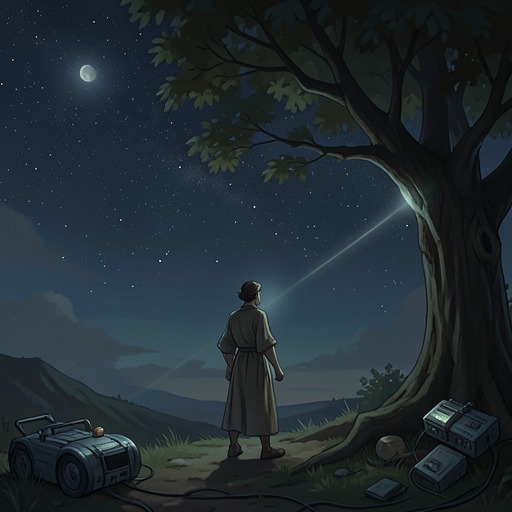
The narrator recalls that scientists were puzzled by the darkness of the night sky: with billions of stars apparently spread in every direction, their light should seem to fill the sky. The explanation described is that the universe has been expanding since the Big Bang, with stars moving away from one another. The more distant stars move faster, some nearly at the speed of light, so their light has not reached Earth.
The explanation matters to the narrator not only as established scientific reasoning but as something that can be worked through independently by looking at the night sky and thinking. That emphasis connects cosmology to the narrator’s trust in observation and logical inference: a vast question becomes approachable through a pattern visible above one’s head.
A Reversing Cosmos
The account then extends beyond the explanation of darkness into a conjecture about the universe’s future. The narrator imagines expansion eventually ending, the stars slowing like a ball thrown into the air, and then beginning to fall toward the universe’s center. In this imagined reversal, the stars would move toward Earth increasingly quickly, and their light would no longer leave the sky dark.
The passage gives this speculation a striking consequence: a sky filled with the blazing light of billions of falling stars would signal that the world was nearing its end. The Big Bang therefore anchors both an explanation of the present and a speculative cosmic cycle. The reasoning begins with an observable darkness and ends by imagining its opposite as an omen of finality.